
Sewer backup emergency: protect the house first
When the line is broken or blocked beyond a cleanout, waste has nowhere to go but your drains. Quick steps limit what the water touches.
- 1Stop all water use. Every flush and wash adds to the backup.
- 2Close off the area. Keep children and pets out and wear gloves if you must handle anything.
- 3Do not use caustic cleaners. They harm pipes and create a hazard for the plumber.
- 4Call and ask about help. Describe where the backup is showing, because that guides the first visit.
Blockage or broken pipe: a camera tells the difference
Not every sewer backup needs a repair. A blockage clears with a cable or hydro jetting, and a broken, bellied or root-invaded line will clog again until it is fixed.
A camera on a flexible cable shows which one you have. We use sewer camera inspection to find offsets, cracks, collapses and root intrusions before recommending a repair, so the scope matches the damage.
Spot repair, lining and full replacement
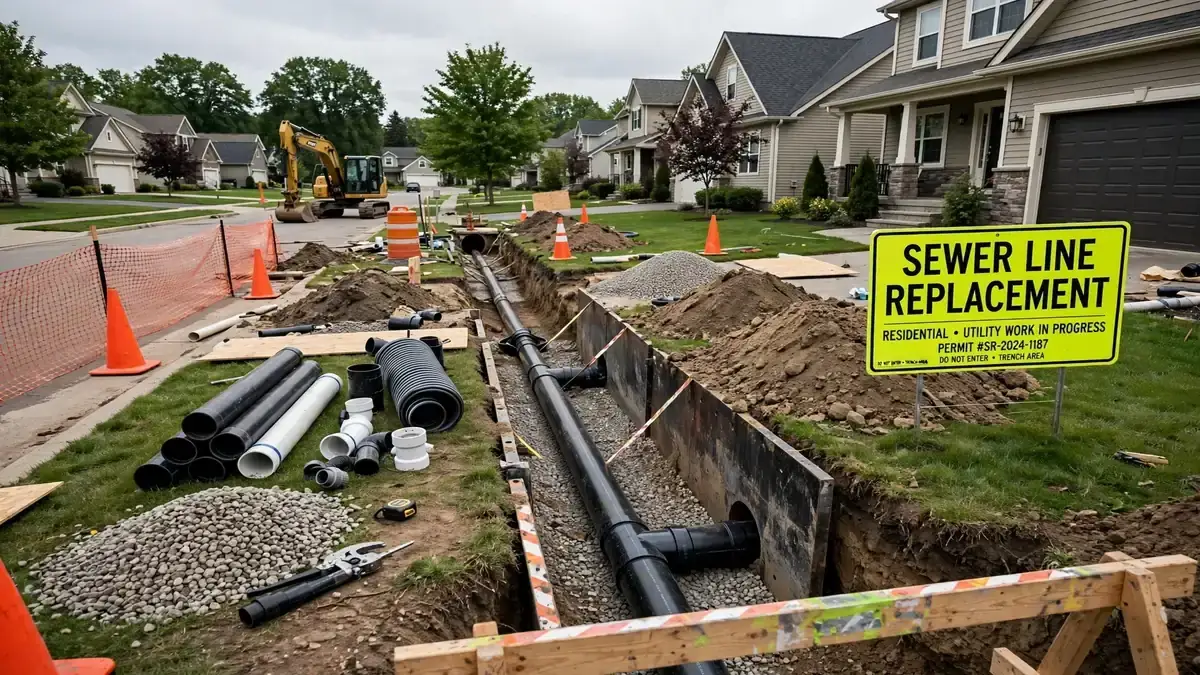
A spot repair replaces one damaged section and works where the rest of the line is sound. Trenchless lining feeds a resin-saturated liner through the pipe and cures it into a new pipe inside the old one, which avoids digging up lawns and driveways. Full replacement uses a trench or pipe bursting when the line has failed along its length.
Which one fits depends on the pipe material, how much is damaged and what sits above the line. Trees, driveways and patios all change the answer, and we explain trade-offs honestly.
Cast iron, clay and older pipe materials
Older homes and downtown commercial buildings can still have cast iron or clay drain lines. Cast iron corrodes from the inside out and eventually flakes or cracks, and clay pipe has joints that roots find easily.
Houses from the early twentieth century near Historic Downtown were rebuilt and extended many times, so the pipe on paper may not match what is underground. That is why a camera is worth doing first.
Compare repair methods
| Method | Best for | Trade-off |
|---|---|---|
| Spot repair | One short damaged section | Needs a dig at that spot |
| Trenchless lining | Cracks and root-prone joints in a long run | Needs a pipe that is not collapsed |
| Pipe bursting | Failed pipe over a long run | Needs entry and exit pits |
| Open trench replacement | Collapsed or badly offset sections | Most surface disruption |
Sewer lines in Sanford and Seminole County
Lateral lines in Seminole County connect to either a city sewer main or a septic system, and who owns what changes from one street to the next. Before any dig, we confirm where your property line and the utility connection are, and we call for utility locates as the state requires before excavation.
Sandy Central Florida soil and a high water table in low areas can make trenches collapse and fill with groundwater, which affects the method and schedule. If you also notice slow drains, see drain cleaning for a quick first check.
What sewer line repair costs depend on
Prices vary widely because every line is different. These factors drive it.
Insurance rarely pays for the pipe itself but may cover resulting water damage, so check your policy. Want your real number? Call (407) 964-8940.
Permits and inspections for sewer repair
According to code guidelines, sewer repair is regulated plumbing work under the Florida Building Code, Plumbing, and many jurisdictions require a permit for excavation and replacement. Ask your building department what applies before digging starts.
Call 811 before any dig. Florida law requires a locate request so buried utilities are marked, and a plumber should confirm the marks before the trench opens.
Sewer Line Repair questions in Sanford, FL
Call and ask about availability. Stop water use, keep people away from the backup and call so the plumber knows to bring a camera.
Repeated backups, gurgling toilets, sunken spots in the yard, sewage smell outdoors or slow drains throughout the house all point to a line problem. A camera confirms it.
Often yes, with trenchless lining or pipe bursting, when the pipe condition allows. A camera inspection tells us if a trenchless method will work.
Generally the property owner is responsible from the house to the point where the line meets the utility connection. Confirm the exact boundary with the utility for your address.
Permit rules vary, so ask the City of Sanford or your local building department for your address. We explain what permits the scope typically needs.