
Slab leak emergency: what to do right now
Water under a concrete slab can undermine soil, lift flooring and send a bill through the roof. A hot line leaking under the slab can also scald if the floor is warm.
- 1Shut off the main. Close the valve where water enters the house.
- 2Turn off the water heater. This stops hot water feeding the leak.
- 3Avoid hot or wet floor areas. Keep pets and children off.
- 4Call and ask about help. Tell us what you noticed so we can bring the right locating equipment.
How slab leaks show up
Common signs include a warm spot on the floor, the sound of running water when everything is off, a meter that keeps moving, damp carpet or lifted tile, a musty smell and a sudden jump in the water bill. In some houses baseboards swell or paint blisters near the leak.
These signs overlap with other leaks. Our leak detection service confirms whether the leak is under the slab or elsewhere.
Why slab leaks matter in Central Florida
Most homes in this part of Seminole County are built on concrete slabs, so supply lines often run beneath the floor. Copper lines can wear through at bends and joints, and shifting sandy soil and mineral content can speed that process over decades.
The City of Sanford's water quality report does not state a hardness figure, so test your tap or ask the utility about the water in your area. Whatever the cause, we find the leak before we cut.
Three ways to fix a slab leak
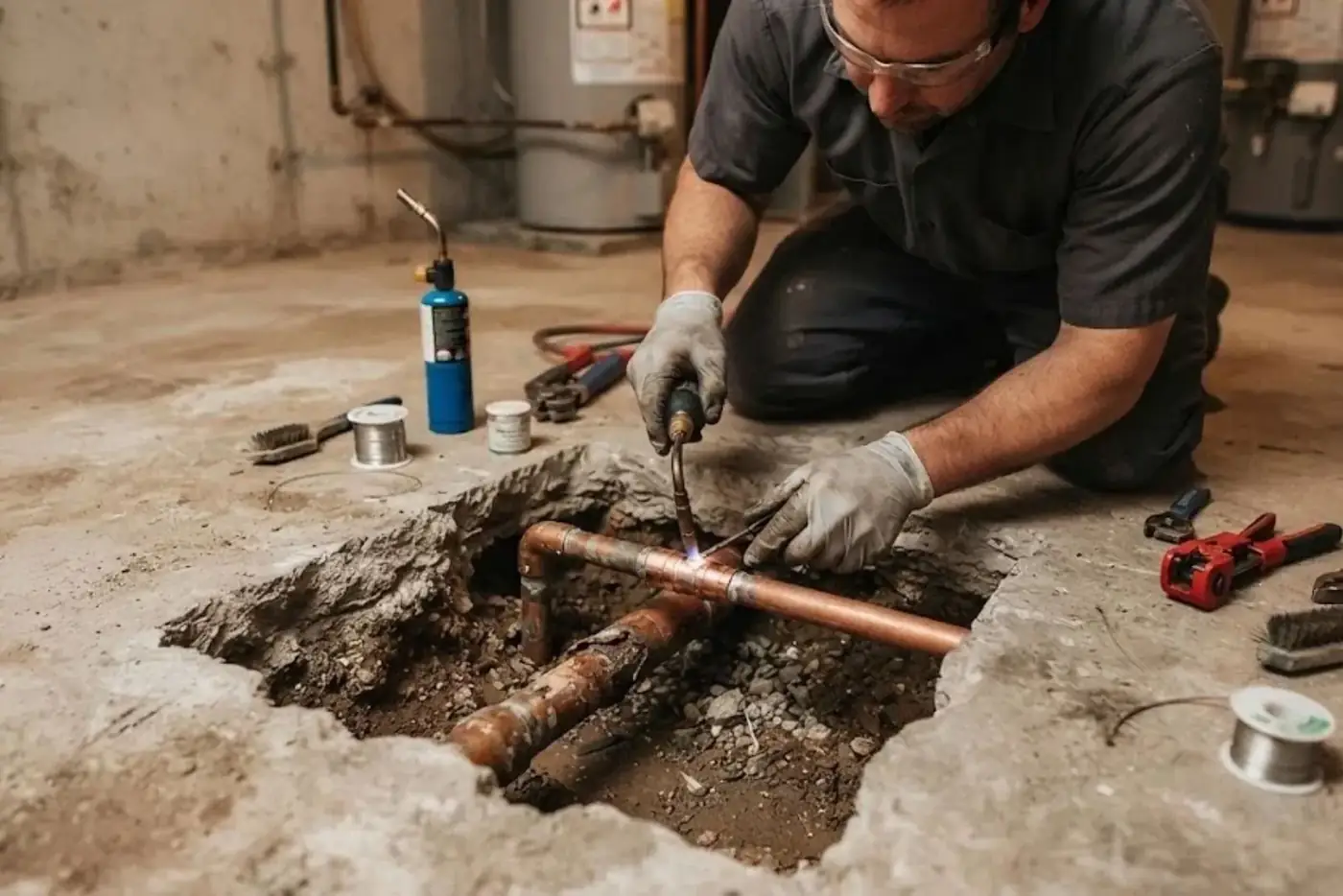
A direct repair opens the slab at the leak, replaces the damaged section of pipe and patches the concrete. A reroute abandons the leaking line and runs a new one through the attic or walls, which avoids more cuts in the slab. A repipe replaces the supply lines throughout if several slab lines are failing.
Which is best depends on how many leaks there are, how old the pipe is and how much floor finish is at stake. If your lines are old and failing, a repipe may cost less than repeated repairs.
Repair method comparison
| Option | Best for | Trade-off |
|---|---|---|
| Direct repair | One leak, newer pipe | Cuts the slab and floor finish |
| Reroute | Leak in a hard-to-reach line | Lines run through attic or walls |
| Repipe | Several leaks or aging pipe | Larger project and cost |
Drying, flooring and insurance
After a slab leak, the area under flooring needs to dry. We stop the leak, and a restoration company can handle drying and mold prevention. Keep photos of damage and the repair record for any insurance claim.
Insurance often covers resulting water damage but not the cost to access the leak, so ask your agent before the work starts.
What slab leak repair costs depend on
Ask about price before work starts.
Insurance rules vary widely for slab leaks. Ask your agent what is covered. Want your real number? Call (407) 964-8940.
What the code expects from a slab repair
According to code guidelines, a repair under a concrete slab must use materials approved by the Florida Building Code, Plumbing, and any rerouted line has to be pressure tested before the floor is patched.
Ask your building department whether the repair needs a permit, and ask the plumber to show the test result before walls or flooring are closed.
Slab Leak Repair questions in Sanford, FL
Call and ask about availability. Shut off the main and the water heater, avoid wet or hot floors and call.
We use pressure testing, acoustic listening and thermal imaging to locate the leak, then open the smallest area that reaches it.
A long-running leak can wash out soil under the slab. That is why fast action matters.
Direct repair works for a single leak in good pipe. Rerouting avoids more cuts when pipe is old or the leak is hard to reach.
It depends on the method and access. We tell you the schedule once the plan is chosen.