
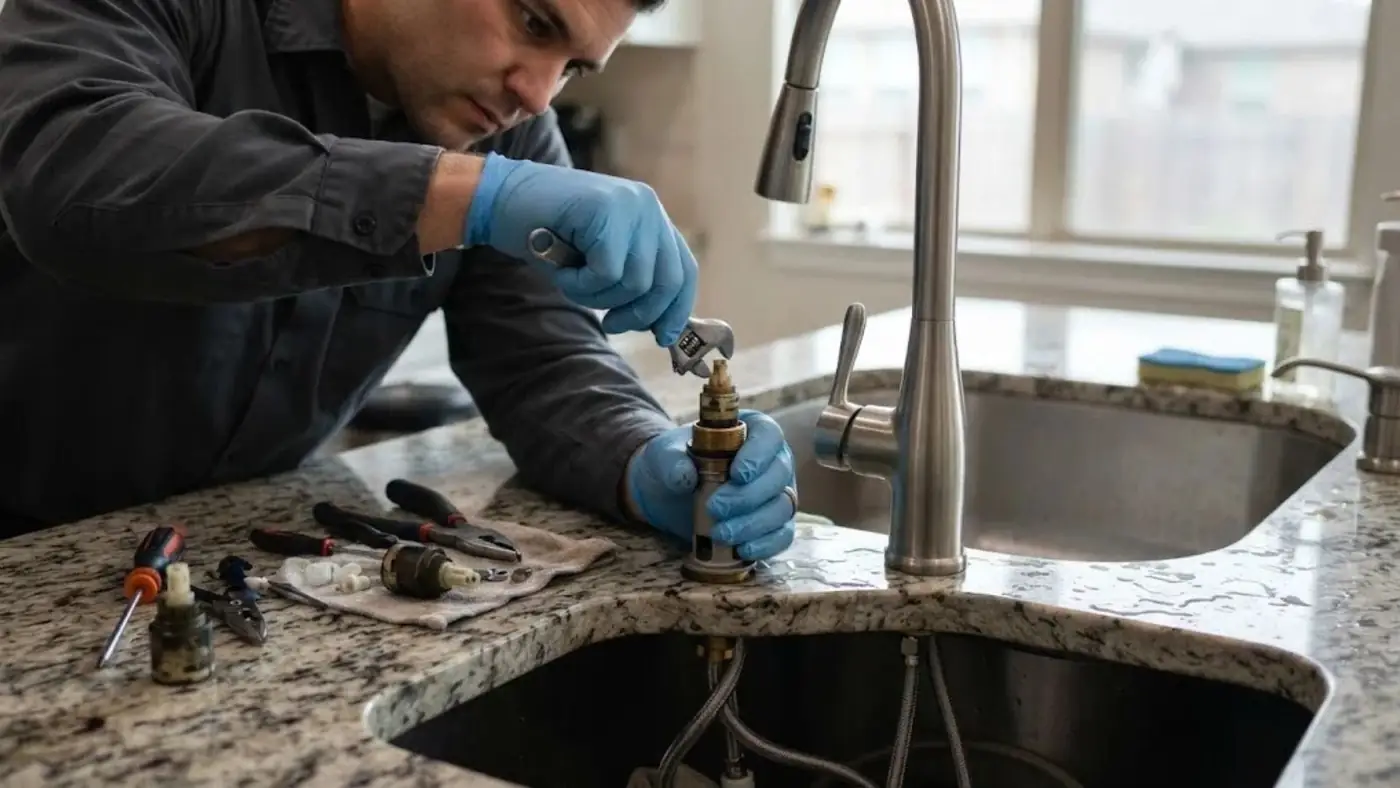
Faucet or supply line leak emergency: stop it fast
Most sink and tub emergencies come down to a failed supply line, a corroded shutoff or a faucet body that has split. The first fix is always to cut the water.
- 1Close the angle stop. The small valve under the sink turns clockwise.
- 2Shut the main if it sticks. Old stops often seize and should be replaced.
- 3Clear the cabinet. Pull items out so the cabinet floor can dry.
- 4Call and ask about help. Tell us whether the water comes from a faucet, a supply line or the drain.
Dripping, loose and low-flow faucets
A drip comes from a worn cartridge, washer or seat. A loose handle means a stripped set screw or worn stem, and low flow often comes from a clogged aerator or a partly closed stop. Kitchen faucets add sprayers and diverters that fail on their own schedule.
In many cases a cartridge swap is cheaper than a new faucet. If the faucet is old, pitted or no longer carries parts, replacement is the better value.
Tub faucets, shower valves and handles that will not shut off
A tub spout that drips or a shower valve that will not fully close is wasting hot water as well as cold. The cause is usually a worn cartridge or a stem seal, and repair means opening the wall access or removing the trim.
Older homes may have a valve with no shutoff, which means closing the whole house to work on it. We often add stops during the repair so future jobs are simpler.
Replacing stuck angle stops and old supply lines
Braided supply lines last years, not decades, and rubber washers inside old stops harden. A line that has been under pressure for a long time can burst without warning, often while you are away.
We replace both when they show corrosion or have not moved in years. Where the leak is behind a wall or in a place you cannot see, leak detection confirms the source before we cut.
Fixtures
| Problem | Likely cause | Usual fix |
|---|---|---|
| Drip from the spout | Worn cartridge or seat | Replace the cartridge |
| Leak under the sink | Failed supply line or fitting | Replace the line or fitting |
| Valve will not shut off | Stuck or worn stop | Replace the stop |
| Low flow | Clogged aerator or stop | Clean the aerator, replace the stop |
| Tub spout drips | Worn cartridge or diverter | Repair the valve |
Hard water, scale and Sanford faucets
The City of Sanford's annual water quality report covers chlorine, fluoride and lead and does not state a hardness figure. Test your tap or ask the utility, because mineral buildup clogs aerators and shortens cartridge life where water is hard.
If faucets and fixtures all show scale, a water softener or filtration system may be worth discussing after you know your numbers.
What faucet repair costs depend on
Clear pricing before work starts.
Homeowners insurance typically covers sudden water damage from a burst line but not wear and tear on the faucet. Want your real number? Call (407) 964-8940.
Water use guidelines for replacement faucets
If a faucet is past repair, the EPA WaterSense label marks bathroom faucets that use no more than 1.5 gallons per minute, according to the program's published specification. A labeled model cuts water use without a loss in everyday performance.
Supply lines and shutoff valves under the sink should match the fixture instructions, so check the manufacturer guidelines before you buy parts.
Faucet Repair questions in Sanford, FL
Call and ask about availability. For a burst supply line or a faucet that will not shut off, close the valve under the sink or the main water valve and call us.
Often yes. A new cartridge or seat usually restores a faucet that is otherwise in good shape. If the faucet is old or corroded, replacement is the better value.
A clogged aerator, a partly closed stop or a failing cartridge is the usual cause. Low pressure on every faucet is a different problem.
Yes. A valve replacement usually requires opening the wall behind the trim, and we explain the access plan before starting.
Do not force it. Shut the main water valve and call us, since a forced stop can break and make the leak worse.