
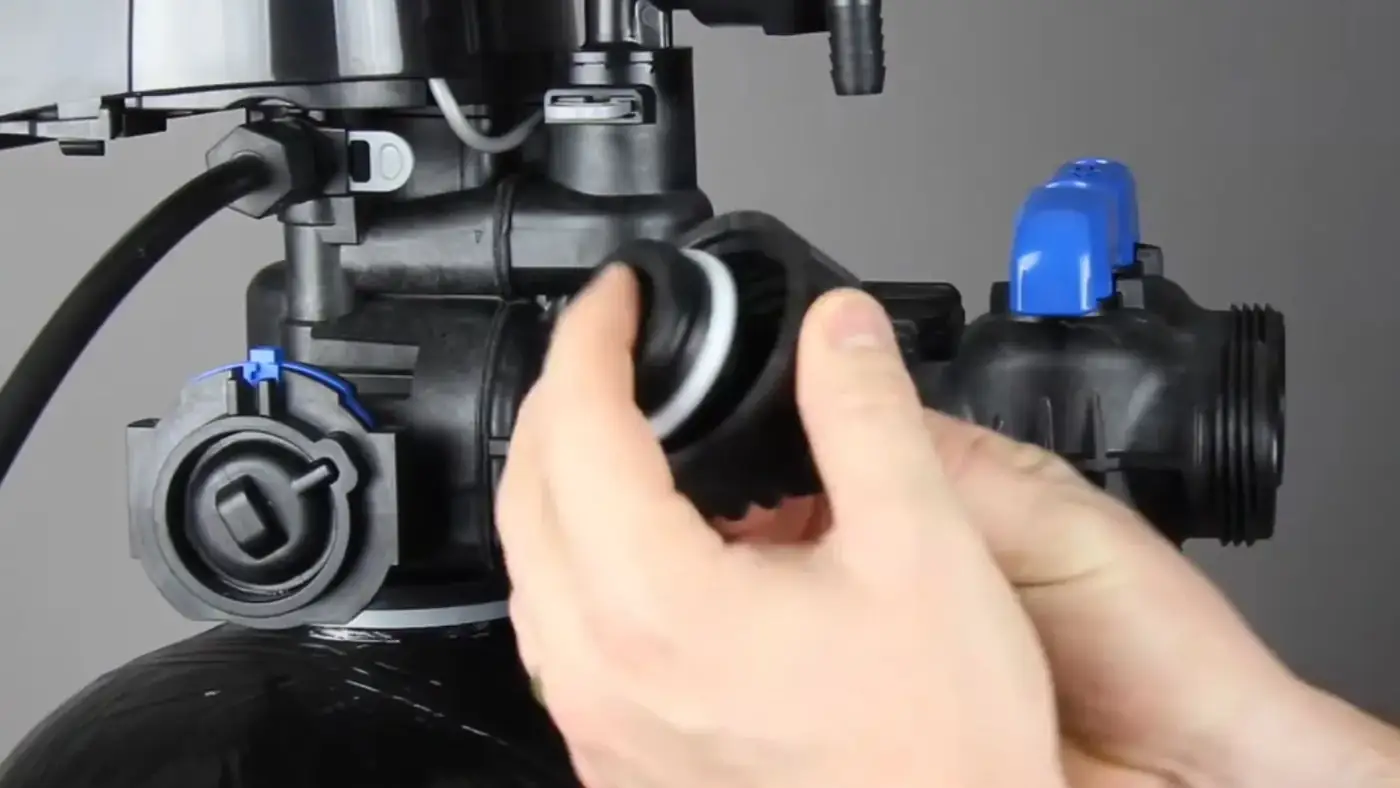
Start with bypass
Put the softener in bypass, which routes household water around the unit. Most systems have a lever or a set of valves on the back of the head.
Dry the area with a towel and watch. If the water stops, the leak is inside the softener. If it continues, the leak is in the plumbing or a different appliance.
Leaks at the head and fittings
The head is where the control valve and the water lines meet the tank. O-rings and connection nuts loosen over time, and a slow drip at a union is common.
Tighten connections by hand and a small turn with a wrench. A worn O-ring or a cracked fitting is cheap to replace and should not be ignored.
Leaks from the drain line
The softener's drain line carries brine and rinse water to a drain during regeneration. A loose clamp, a kink or a clogged drain can send water onto the floor.
Run a manual regeneration and watch the line. Check that it ends above the drain with an air gap and is not submerged.
Softener leak sources
Match what you see with the likely cause.
| Where water appears | Likely cause | Usual fix |
|---|---|---|
| At the head | Worn O-ring or loose union | Replace the O-ring, snug the union |
| From the drain line | Kink, clog or loose clamp | Clear and secure the line |
| Around the brine tank | Overfill or stuck float | Reset the float, check the valve |
| From the tank body | Crack | Replace the system |
Cracked tanks and brine tank overflows
A cracked resin tank is not repairable. A brine tank that overflows has a stuck float or a salt bridge, and a bridge can keep the tank from drawing brine.
Break up a salt bridge with a broom handle, check the float and clear any sediment. If the tank is cracked, the system needs replacement.
Bypass valve and unions
Bypass valves fail with age and mineral scale. A valve that will not move fully or drips at the stem needs replacement.
While we are there we often add shutoff unions so future service is easier. Our water softener and filtration page explains what we install and service.
When a plumber should take over
Call a plumber if the leak is at a copper or plastic supply line, if the bypass valve fails or if the water will not stop with the system in bypass. A leak on the supply side can flood a garage.
If you cannot find the source, leak detection confirms it quickly before damage spreads.
Check the brine tank and the salt
A softener that leaks from the brine tank often has overfilled it. A faulty float, a stuck valve or a drain restriction lets water keep entering the tank.
Remove the extra water with a wet vac and check the float. If water keeps coming in, the control valve may need service.
When the leak is not the softener
Condensation on a cold tank, a leaking water heater nearby and a dripping supply line can all look like a softener leak. Dry everything and watch where the first drop forms.
Condensation shows on the outside of the tank on humid days in Florida, and it can fool you. A towel wrapped around the tank for an hour will tell you whether it is wet from the inside or the outside.
Preventing the next leak
Keep the area around the softener dry and clear so you can spot water early. Check the brine tank level and the drain line every few months, and replace salt with the right kind for your system.
Have the system serviced on a schedule, and replace O-rings and gaskets when they harden. A small leak caught early is a cheap fix.
Guidelines for softener installation
According to manufacturer guidelines, a softener drain line needs an air gap so wastewater cannot siphon back into the system. The Florida Building Code, Plumbing sets the same principle for drains, so check yours if the unit was installed by a past owner.
Help beyond Sanford
If a softener is flooding a garage in Lake Mary or Longwood, call the same number. See our Lake Mary emergency plumber page for how that area is served, and shut the softener bypass valve while you wait.
Softeners and Sanford's water
The City of Sanford's annual water quality report says the city's drinking water comes from seventeen groundwater wells in the Floridan Aquifer, disinfected with chlorine. It does not publish a hardness figure.
If you are not sure you need a softener, test your tap or ask the City of Sanford Utility Department for the numbers before you replace one. A system that is oversized or set wrong can waste salt and water.
Sanford homes often put the softener in the garage next to the water heater, and a leak there can reach stored items quickly. Lake Mary and Longwood water comes from their own utilities, so the numbers differ, and our service areas page explains where we work.
Questions about this in Sanford, FL
Common causes are a loose fitting, a worn O-ring, a drain line problem or a cracked tank.
Put it in bypass to stop the leak and keep water flowing to the house while you arrange repair.
No. A cracked tank is replaced.
Test your water or ask your utility for the hardness figure. The City of Sanford report does not give one.