The supply side
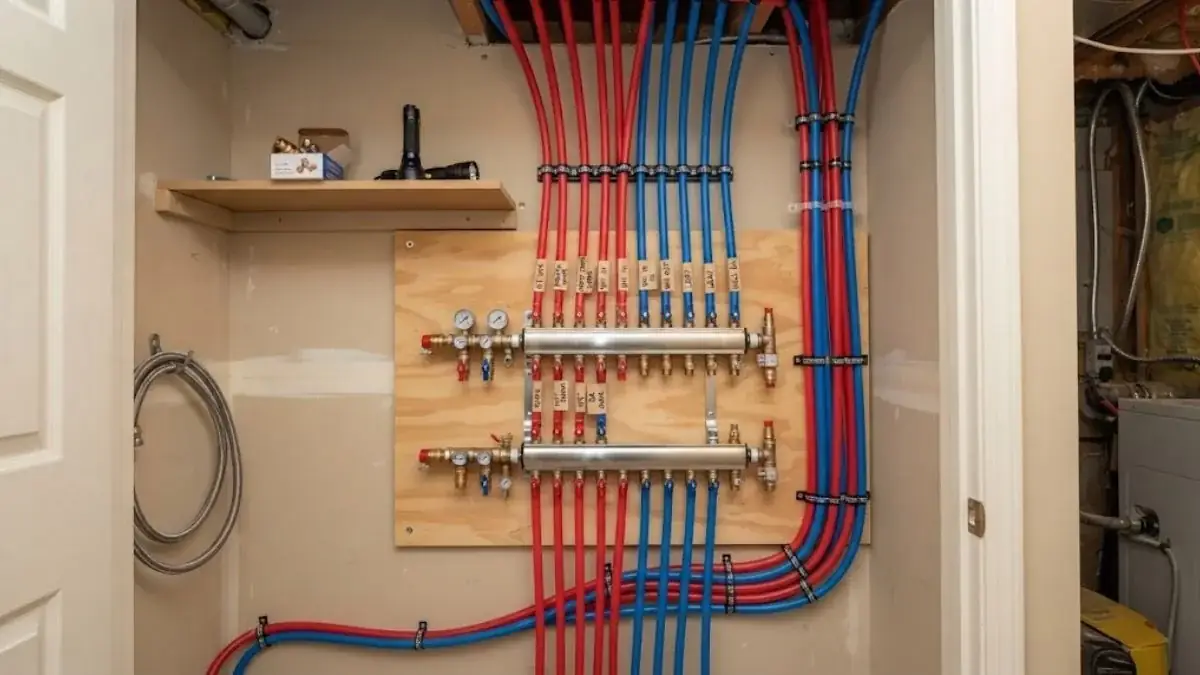
Water enters the house through a service line from the meter, passes a main shutoff valve and splits into cold lines and a branch to the water heater. Hot and cold lines then run to each fixture.
Supply lines are under pressure all the time, which is why a failure sends water out quickly. Pipes may be copper, PEX, CPVC or older galvanized steel.
The drain side
Drain lines work by gravity. Each fixture has a trap, a curved pipe that holds a little water to block sewer gas, and the drains join into a main line that leaves the house to the sewer or a septic system.
Because gravity does the work, drains must slope. A section that sags collects waste and clogs repeatedly.
The three systems at a glance
Each part has its own job and its own typical failures.
| System | Job | Typical failure |
|---|---|---|
| Supply | Brings in pressurized water | Leaks and bursts |
| Drain | Carries waste out by gravity | Clogs and backups |
| Vent | Lets air into the drains | Gurgling and odors |
The vent side
Vents let air into the drain system so water flows smoothly, and they carry gases out through the roof. Every fixture needs a vent path, either its own or one shared with others.
Blocked vents cause gurgling and slow drains. They are the part of the system people forget exists.
The water heater
A tank or tankless heater sits on the supply side, heating water for the hot lines. It needs a relief valve, a shutoff and, for gas models, a vent and a gas connection.
Water heater repair and water heater installation cover these systems in more detail.
Slab, crawlspace and attic routing
Where the pipes run depends on the house. Slab homes have drains under the concrete and supply lines in the slab or in the attic. Raised homes run lines through a crawlspace.
That routing decides how hard a leak is to reach. A leak in the attic is an easy fix compared with one under a slab.
What commonly fails
The usual failures are worn fixtures and supply lines, water heaters at the end of their life, clogged drains and corroded old pipe. Leaks under slabs and in yards cause the costly surprises.
Our leak detection page explains how hidden failures are found.
Where to start when something goes wrong
Shut off the closest valve, then the main if you cannot stop it. Turn off the water heater for any leak at the tank and stop using drains for a backup.
Then call a plumber and tell them what you did. A clear description of what you saw speeds the diagnosis.
Pressure, flow and why they differ
Pressure is the force pushing water through the pipes, and flow is how much arrives at the tap. High pressure with narrow pipe still gives weak flow, which is why a clogged aerator and a leaking service line feel similar.
A pressure gauge on a hose bib shows your pressure, and a regulator at the main protects fixtures from spikes. Low flow at one fixture is local, while low flow everywhere points to the supply.
Fixtures and appliances connected to the system
Sinks, toilets, tubs and showers connect to supply and drain. Dishwashers, washing machines, ice makers and water softeners tie into the same lines with their own hoses and drains.
Every connection is a possible leak point, and appliance hoses are among the most common sources of home water damage. Check them when you check under the sinks.
Shutoff valves every owner should find
Find the main water valve, usually near the meter or where the line enters the house, and the shutoff under each sink and behind each toilet. Turn each one gently once a year so it does not seize.
Know where the water heater shutoff and the sewer cleanout are as well. In an emergency, knowing these locations saves minutes, and minutes decide how much water ends up on the floor.
What to do if something goes wrong
If a pipe bursts, close the main valve, switch off power to wet areas and call a plumber. If a drain backs up, stop using water and keep children and pets away from the overflow.
Plumbing in Florida is built to the Florida Building Code, Plumbing, so a plumber can explain why a fixture is vented or trapped the way it is.
Sanford plumbing basics
The City of Sanford's annual water quality report says the city's water comes from seventeen groundwater wells in the Floridan Aquifer and is chlorinated. That is the water entering a Sanford home's supply side, and your own pipes decide how it reaches the tap.
Older houses near Historic Downtown often have a mix of pipe from several eras, while newer subdivisions use PVC drains and PEX or CPVC supply. Knowing which you have helps when you plan a remodel.
If you live in Lake Mary or Longwood, see our Lake Mary page for how we cover those towns, and ask your own utility for its water report.
Questions about this in Sanford, FL
Sanford's water comes from groundwater wells in the Floridan Aquifer, according to the City of Sanford's report.
A trap is a curved pipe under a fixture that holds water to block sewer gas from entering the house.
Vents let air into the drain system so water flows freely and traps stay full.
Turn everything off and watch the meter. If it moves, there is a leak somewhere.